
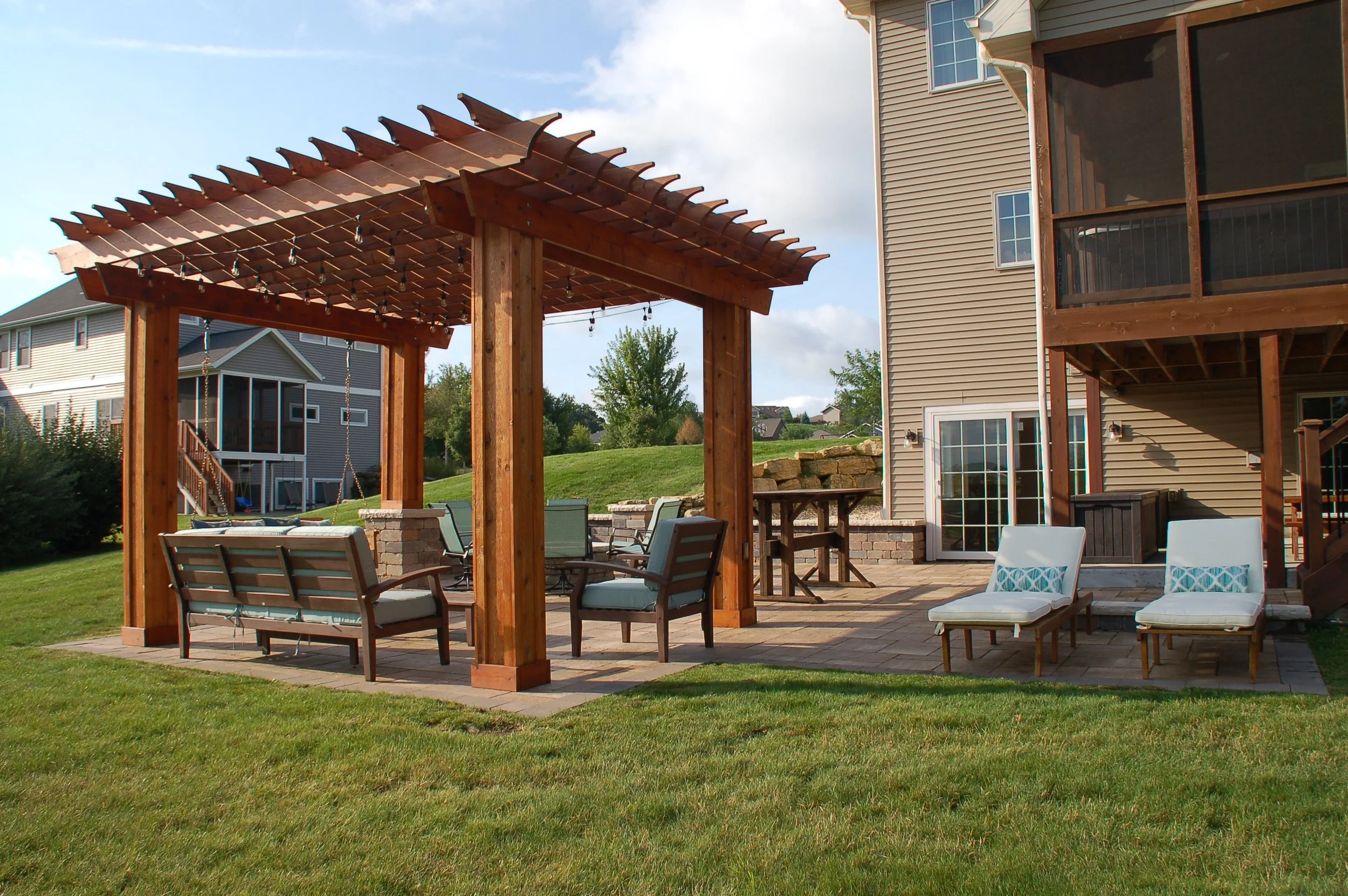
Most landscaping projects begin with a phone call about something specific. A patio. A retaining wall. A fire pit someone saw at a neighbor's house. And that makes sense. You see something you like, and you want it in your yard.
But here is what happens more often than it should. A homeowner calls a landscaping company, describes what they want, gets a quote, and the crew shows up to start building. No site analysis. No thought given to how the new patio connects to the rest of the property. No consideration of drainage, grading, sightlines, or how the space will actually be used once it is finished.
The result might look fine at first. But over time, the cracks start to show. Water pools where it should not. The patio feels disconnected from the house. The plantings struggle because nobody evaluated the soil or sun exposure. And the homeowner is left wondering why their investment does not feel like what they imagined.
At Landscape Architecture, LLC, we have spent over 25 years working with homeowners across the greater Dane County area, including Stoughton and Oregon, WI. And if there is one thing we have learned in that time, it is this: the quality of the finished project is almost always determined by the quality of the design that preceded it.
Related: Top Reasons Local Landscaping Companies Are Best for Your Mt. Horeb and Verona, WI Backyard Design
What "Design First" Actually Means
When we say design first, we are not talking about picking colors from a catalog or choosing between two patio shapes. We are talking about a process that treats your outdoor space the way an architect treats the interior of your home. With intention, structure, and a deep understanding of how the space needs to function.
Every project we take on begins with a consultation and site analysis. Before we discuss materials or timelines, we need to understand:
How the property is graded and where water moves during a heavy rain
What the soil conditions are and how they affect both hardscape stability and plant health
Where the sun hits at different times of day and across different seasons
How you actually want to use the space (entertaining, relaxing, cooking, play, all of the above)
What the views look like from inside the house and from different points in the yard
How the new project relates to existing structures, trees, and features
That information shapes everything that follows. It is the difference between a landscape that works beautifully for years and one that starts creating problems the first time it rains.
What Happens When Projects Skip the Design Phase
This is not hypothetical. We see it regularly. Homeowners in Stoughton, WI, and Oregon, WI, call us to fix or redesign projects that were installed without a proper plan. The issues tend to follow predictable patterns.
Drainage failures. A patio was installed without accounting for the grade of the property, and now water runs toward the foundation instead of away from it. This is one of the most common and most expensive problems to correct after the fact.
Retaining walls that are not engineered for the site. A wall might look solid the day it goes in, but if it was not designed for the specific soil pressure, water load, and grade conditions on your property, it can shift, lean, or fail within a few years.
Plantings in the wrong locations. Shade-loving plants are placed in full sun. Moisture-sensitive species are installed in low, wet areas. Ornamental trees are planted where they will eventually crowd the house or block a key sightline. These are design problems, not installation problems, and they are entirely preventable.
Spaces that do not connect. A fire pit that feels like it is stranded in the middle of the yard. A patio that ends abruptly instead of flowing into the surrounding landscape. An outdoor kitchen that is too far from the house to be practical. When each element is chosen and installed in isolation, the overall space never comes together.
The common thread in every one of these situations is the same. The project started with installation instead of design.
How a Landscape Architect Thinks Differently
There is a meaningful difference between a landscape contractor and a landscape architect, and it is worth understanding before you hire anyone for a significant project.
A contractor is skilled at building things. They know how to lay pavers, build walls, and install plantings. That is valuable work, and good contractors are essential to any project.
A landscape architect is trained to design systems. We think about how all the elements of your outdoor space interact with each other and with the natural conditions of your property. We are solving problems you may not even know you have yet.
For example, when we design a paver patio, we are not just selecting a material and laying out a shape. We are thinking about:
The base preparation required for your specific soil type (and in southern Dane County, that often means dealing with clay soils that hold water and shift with freeze/thaw cycles)
How the patio pitch and drainage tie into the overall grading of the property
Where the transitions happen between the patio and the lawn, plantings, or other hardscape features
How the patio will look and function in January, not just July
Whether the design supports the next phase of the project if you decide to add a fire feature, outdoor kitchen, or seating wall in the future
That last point matters more than most people realize. A well-designed landscape can evolve over time. A poorly designed one locks you into whatever was built first, and every addition becomes a workaround.
Why This Matters in Stoughton, WI, and Oregon, WI
Homeowners in Stoughton and Oregon enjoy a lot of what makes the Dane County area special. Established neighborhoods with character. Properties with real acreage and room to work with. Proximity to Madison without the density.
But these communities also come with site conditions that demand thoughtful design:
Clay soils are common throughout the area and have a direct impact on drainage, hardscape stability, and plant selection. Clay expands when wet and contracts when dry, which means any hardscape built on it without proper base preparation is at risk of shifting.
Freeze/thaw cycles in southern Wisconsin are aggressive. We routinely see 40 degree temperature swings within a 48-hour period during the shoulder seasons. Materials, base layers, and drainage systems all need to be designed to handle that kind of movement.
Varied topography. Many properties in Stoughton and Oregon sit on land with natural slopes, elevation changes, or low areas that collect water. These are not obstacles. They are opportunities if the design accounts for them. A slope becomes a terraced planting bed or a retaining wall with built in seating. A low spot becomes a rain garden or a redirected drainage channel.
Mature trees and established landscapes. Older properties often have large trees with extensive root systems. Any new construction near those trees needs to be designed with root protection in mind, or you risk damaging the very features that give the property its character.
A landscaping company that jumps straight to installation may not evaluate these conditions thoroughly. A design-first firm will, because that evaluation is the foundation of every decision that follows.
Related: Locate Landscaping Companies Near Me for Comprehensive Madison, WI Landscape Services
Design Creates Better Outcomes at Every Scale
One of the misconceptions about working with a landscape architect is that it is only for large, high-budget projects. That is not the case.
Design matters just as much for a simple planting refresh as it does for a full outdoor living space. A small project done thoughtfully will always outperform a large project done without a plan.
Here is what that looks like in practice:
A planting project benefits from a design that accounts for bloom timing, mature plant size, sun and shade patterns, and soil conditions. The result is a garden that looks intentional from day one and improves every season.
A paver patio benefits from a design that addresses base preparation, pitch, drainage integration, material selection for the local climate, and how the patio connects to the house and surrounding landscape.
A retaining wall benefits from a design that evaluates soil pressure, water load, frost depth, and the structural requirements for the specific height and grade change involved.
A full outdoor living space with a fire feature, kitchen, seating areas, lighting, and plantings benefits from a design that treats all of those elements as one integrated environment rather than a collection of separate installations.
In every case, the design is what ensures the finished project looks right, functions properly, and lasts.
The 5 Year Hardscape Guarantee
We stand behind our work with a 5 Year Hardscape Guarantee, which is uncommon in our market. Most landscaping companies in the Dane County area do not offer anything close to this, and there is a reason for that. A guarantee like this is only possible when the design and installation are both done correctly from the start.
We are able to offer it because of how we approach every project. The design accounts for the site conditions. The base preparation follows specifications appropriate for the soil and climate. The materials are selected for longevity, not just appearance. And the installation follows the design precisely, without shortcuts.
When all of that is in place, the work holds up. It is that straightforward. This guarantee is not a marketing gesture. It is a direct reflection of our process, and it is something we take seriously.
Quality Installation Follows Quality Design
Our founder, Joe Hanauer, started Landscape Architecture, LLC in 1997 after working for companies where design was an afterthought. The philosophy at those companies was simple: do not worry about the design, just sell the job. Good enough was good enough. That approach never sat right with Joe, and it still does not.
He started this company with a different belief. Every landscape project, no matter the size, needs to begin with quality, thought-out design. A design that is functional with form. Once the design is right, the focus shifts to quality installation. We do things right the first time.
Our team brings over 25 years of experience in landscape architecture, horticulture, and construction. Joe holds a Bachelor of Science in Landscape Architecture with a second major in Horticulture from the University of Wisconsin, Madison. He is a Registered Landscape Architect and a member of ASLA and NALP. We are a Unilock authorized contractor, and our work has been recognized as a finalist in the Unilock Awards of Excellence.
But none of those credentials matter if the design is not right. That is always the starting point. It is what separates a landscape that impresses on day one and still performs in year ten from one that starts showing problems after the first Wisconsin winter.
Let's make sure the design is right before the first shovel hits the ground.
Related: The Role of Landscaping Companies in Crafting Exceptional Outdoor Areas in Middleton and Verona, WI
