What Is The Difference Between Landscape Architects, Landscape Designers, & Landscape Contractors?

Landscape design has a unique set of challenges that makes hiring a qualified person very important.  Architects and interior designers are trained to design spaces as are landscape architects.  But, the landscape is unique in that it deals with a dynamic medium. Living plants that change and evolve over time.  And, environmental factors such as grading, drainage, and seasonal change.  There are many professionals who work in the landscape industry.  From horticulturists to landscape designers and landscape architects.  How does a landscape contractor fit in.  What are the differences?  Which professional is best for you?

IMG_4566.jpg

Landscape Architect or Landscape Designer?

In Wisconsin and most states, Landscape Architects are licensed and certified to use the title Landscape Architect.  This means, to be a Landscape Architect, an advanced degree is needed, the required minimum amount of years working under a licensed Landscape Architect must be met, the Landscape Architecture Registration Exam must be passed and Continuing Education Units are required each year. 

The first Landscape Architect was Frederick Law Olmsted, the designer of Central Park in New York. He studied surveying, engineering, chemistry, and farming.  He traveled extensively in Europe visiting parks and estates.  From his experiences and training, the art and practice of Landscape Architecture began.  

In schools today Landscape Architect students are trained in design, horticulture, civil engineering, conservation, environmental studies, and structures.  This well versed and broad knowledge provide an unique ability to understand not only design; but grades/ elevations, structures, plants and the environment.

When working with a Landscape Architect you should expect a quality drawn landscape plan.  Most often this is generated using computer aided design (CAD).  Many Landscape Architects produce 3-D drawings as well as 2-D plans.

Landscape Architects get involved in many projects such as:

  • Residential Design

  • Healing Gardens

  • Bioremediation

  • Green Roofs

  • City Planning 

  • Park Design

  • And almost anything to do with our environment.

When contacting landscape professionals be sure to ask if the person is a Landscape Architect as few landscape contractors employ Landscape Architects.  Most company representatives you meet with will be a landscape designer or a horticulturist.  If you would like an idea of how much landscaping costs please follow the link.

landscape designer has no formal training or education requirement although many have both.  Formal training may be from a technical college in a related field such as horticulture or landscape design.  A landscape designer may have a degree in Landscape Architecture but lacks work experience or has not passed the board exam.  A landscape designer may have experience working in the landscape industry.  However, in Wisconsin, there is no regulation defining what a landscape designer is.  A person with the title of Landscape Designer may have no experience in landscape or design. 

Field experience however, is very important and can develop a very qualified landscape designer.  It it recommended to  understand the designers background and be sure to be comfortable with their experience.  A qualified and experienced landscape designer should be able to show you many beautiful pictures of their own projects.   

What is a horticulturist?  A horticulturist is a trained plant specialist.  Horticulture is the study and science of the cultivation of plants.  Many horticulturist are graduates of a technical college or have Bachelors of Science in Horticulture.  However, similar to landscape designers, in Wisconsin, there is no regulation or credential for horticulturists.  Horticulturists know plants, but don't necessarily have any training in design, structures or grading & drainage.

Because horticulturists are plant specialist, this may be a great fit if your project involves only planting design such as a perennial garden.

How do landscape contractors fit in?  Landscape contractors are builders.  They install plants, grass, retaining walls, patios, etc.  The biggest difference is Landscape Architects, landscape designers and horticulturists will specify and design projects.  A landscape contractor will install the project. A landscape contractor may be a Landscape Architect, landscape designer or horticulturist.  Or, they may hire and work with another landscape professional.  

A few very important factors in choosing a contractor is there ability to work with and take direction from your Landscape Architect or other design professional.  This can be difficult if the plan documents do not specify clearly the scope of work.  You and the design professional may expect work to be included in the contract that the contractor did not which could result in additional costs.  

Also important is the contractors warranty.  It is typical in the Madison market for plants to be warrantied for 1 year and hardscape (patios, decks, retaining walls) to be warrantied for 1 year.  My company, Landscape Architecture, LLC; warranties all hardscape workmanship for 5 years.  

What about Design-Build?  A landscape design-build company employs professionals to design the landscape and then they build the landscape. Most design-build companies work with landscape designers or horticulturist.  Few design-build companies employ Landscape Architects so if you would like to work with a Landscape Architect, be sure to research or ask the company what their designers credentials are.  

Design-Build companies should have a seamless transition between the design and construction phases of the project.  Design-build companies earn there money building not designing.  I would recommend working with a company that values landscape design as I believe all successful landscape projects start with quality design and end with quality construction.  

Consider the warranties and quality of construction with Design-build companies just as you would with a other contractor.

In summary, you can broadly generalize that Landscape Architects tend to have more expertise, understanding, and training in materials, hardscapes, and complex grading and drainage situations.  Landscape designers experience can provide a great fit for some projects.  Horticulturists knowledge of plants make them a good fit for planting projects.  Landscape contractors build and install what the other professionals design so need to be able to work well with other professionals.  Design-build companies combine design skills and services with building skills which can be a great fit for many.

Please feel free to contact me if you need assistance with your project.  My background credentials include being a Registered Landscape Architect and a Horticulturist. 

How Much Does Landscaping Cost?

Customers share there dream landscape with me all the time.  Then they say, "How much will the project cost? I have no idea what landscaping costs."  This is a very difficult question question to answer, especially without a full site survey and elevations.  I will do my best to explain some general pricing guidelines and what can contribute to the cost.

It may be helpful to compare buying landscape to the purchase of a new car.  I recently went online to see what a new Jeep would cost.  I was thinking of a Wrangler Unlimited.  I saw the base price was around $27,000 and thought that is not too bad.  Then, I started building the new Jeep online and said yes I want the premium sound, leather interior, and Bluetooth connectivity.  This is a Jeep Wrangler so you want to have the canvas top so it can be a convertible. I live in Wisconsin so a hard top is practical too. I own a landscape company, so yes I should have the trailer package.  The next thing you know the cost of the Jeep is over $42,000.  I have not yet bought this Jeep.  But when I do, I want to be able to get the upgrades that are important to me.  Like most Americans I spend a lot of time in my car.  It is worth it to me to get what I want.

jeep-soft-top-open-air.jpg

Like buying a vehicle and selecting options, there are many upgrades in landscape too.  I believe there is much value in exploring your options prior to purchasing landscape to insure the final product fits your needs and you love it for years to come.  When you work with Landscape Architecture, LLC we believe it is our job to make sure you understand your options.  I would feel I have not done my job if a customer ever said, "I wish I would have known I could have that 'name your product'...".  In the design phase of a landscape project it is our job to educate the customer on the possibilities.  Then as we work through the design and pricing, the customer needs to determine what is important to have and how much they are comfortable spending.  Many parts of a project that I think of as landscape, other may not, for example a driveway.  All outisde elements are interconnected.  They all are part of your experience outside.  As a Landscape Architect and landscape contractor we get involved in everything outside. The most common upgrades are:

  • Patio, Driveway or Front Walk.

  • Brick, Stone or Concrete.

  • Retaining and seating walls.

  • Lighting.

  • Pergola.

  • Fence.

  • Swimming pool or hot tub.

  • Fire pit or fire place (gas or wood burning?).

  • Built-in grill or outdoor kitchen.

  • Front yard and back yard work?

  • Deck

 Each property we work on is unique and has it's own set of complications.  When Landscape Architecture, LLC provides a bid, we live it by it.  Very rarely something completely unforseen happens that can add cost, like discovering buried concrete or old footings.  We analyze every property and take careful grade measurements with a GPS or a transit.  Some items that can contribute to cost are:

  • Is there access for machinery?

  • Is a retaining wall needed in order to have a flat space for a patio?

  • Does soil need to be added or removed?

  • What is the quality of existing soil?  Should the soils be amended?

  • Do plants need to be removed?

  • Is there any concrete removal?

We do small projects for a few hundred dollars and we do large projects in excess of $300,000.  We will work with our customers to make a project as affordable as possible.  We do offer design services for those of you that like to do it yourself.  Or, we are happy to do the hard work like the patio or the large trees while customers do some of the other work themselves.  Either way, we feel all successful projects start with great design. Our landscape designs are produced by a Licensed Landscape Architect.  Cost for a typical landscape design will vary from about $500-$3,000 or more depending on complexity and elements being incorporated.

If you hire Landscape Architecture, LLC to construct your project the cost of the landscape design is included as long as the design fees associated with the project are less than 10% of the construction cost.  In most cases the installation cost is enough that the design fee is waived.

The total cost of landscape will depend on the size of your home and property.  New homes often cost more since the entire yard needs to done while retaining walls and lawns need to be installed.  It is easy however to phase landscape projects.  We are happy to help you through a phasing plan.

A breakdown of some typical cost ranges are:

Front yard planting for most homes range from $2,000 to $10,000.  This will depend on the the size of plants and the size of your home/ property and other related work such as existing plant removal and regrading/ lawn repair.  Front yards are very important for the curb appeal of your property.  Click on the following link for a great example of how landscape can affect curb appeal.

Rear yard planting for most homes range from $2,000 to $20,000.  Again this will depend upon the size of plants and your home/ property.  Rear planting is more than hedges and plants along the house.  The plants can help with the heating and cooling your home. There are many items we consider with planting design as outlined in this link.

A new Front Walk could vary from $1,000 to $18,000 or more depending on if it is concrete, brick pavers or if you need any steps.

patio will vary from a $3,000 to $50,000 or more depending on the size, materials and amenities such as a pergola, seat wall or fire pit. There are many considerations to patio design. A patio with a simple outdoor kitchen area, pergola, seating wall, lighting and a fire pit could range from $40,000 to $130,000 or more.

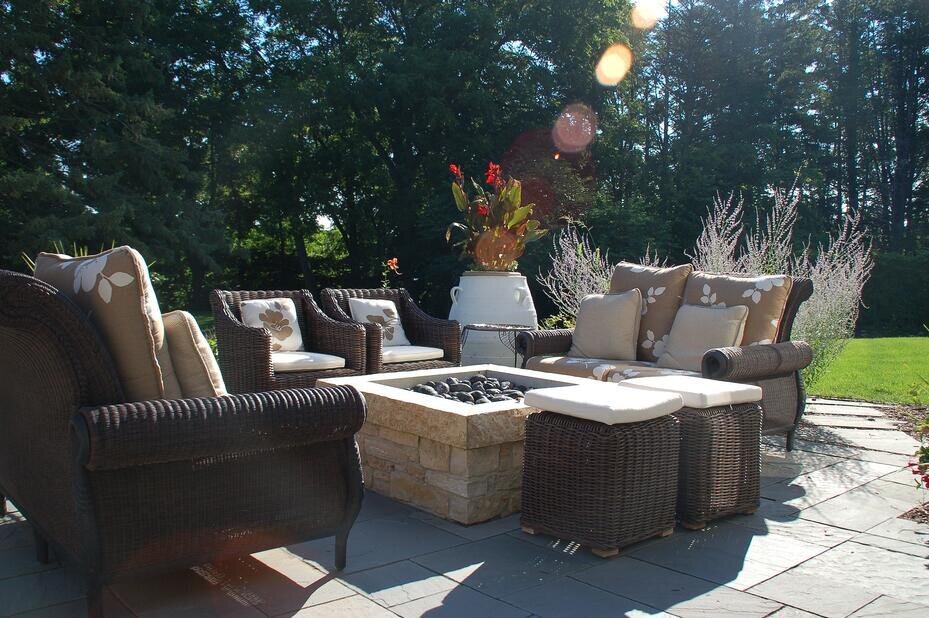
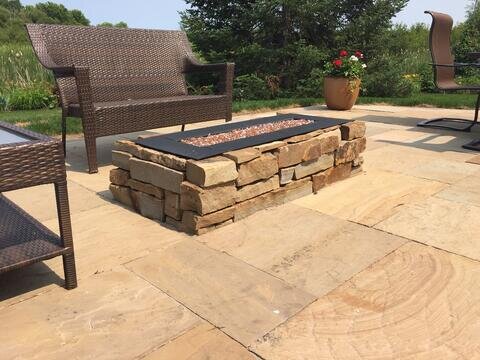
Fire pits have been one  of the most requested elements in the past 5 years.  If considering one, we follow these fire pit guidelines.  Building a standard size (42" exterior dimension) wood burning fire pit will cost $1,500-2,500.  A gas fire pit will add about $2,000-3,000 or more depending on how difficult it is to run a gas line.  Proper sizing of a gas line is essential as gas fire pits can use 65,000 BTU's or more.  These prices are for the fire pit only, any patio around the fire pit and associated repairs of the yard will add cost. 

Landscape lighting has also been very popular in the past 5-10 years.  Homeowners like to enjoy their yards into the evening hours.  Lighting helps create a mood, provides the ability to see and way find, and can add security to your home.   A simple lighting system will start at about $1,500.  Most of our lighting projects range from $3,000-$8,000.  We have done lighting projects exceeding $15,000.

As you see, prices for landscape have a tremendous range.  Much of this is dependent upon the uniqueness of your property but also upon your tastes and desires.  One great thing about landscaping is it is easy to phase work in.  You can build a patio one year and do planting the next.  Hopefully this information will help you with your next landscape project.

The Best Quality Installation of Brick Paver or Stone Patios

Last summer I was at a party in a yard with a large multi-level patio, seating walls, steps, and a fire pit.  A friend asked me if I built the patio.  Imagine the shock in her face when I replied, "No, if I had we would rip it out and redo it".  

She said, “Really, I think it is really nice”. So I pointed what I was seeing:

  • Look at the poor and uneven cuts along the edge of the patio.  

  • Notice the crooked lines in the paving pattern.  

  • See how the bricks are uneven and up and down.  

  • Then look at the steps and the walls.  The rows of block are not level and the capstones have uneven reveals (overhang of the cap stone).  

She said, "You are right, the patio is not installed very well. I didn't notice the details".

This made me think.  We spend a lot of time on the quality of our brick and stone patio installations.  One thought was why?  If people couldn't see or recognize the poor quality, is it worth the effort?  Then I thought, of course it is.  Quality is who I am and what my company is base on. Quality is one of the things that make me proud of our product.  What makes a high quality brick or stone patio installation?

Design.  The old question, form or function?  To me, if a patio or space is not functional then why have it.  But, if you can design a patio to be functional and give it form then you have done something special.  I believe the first step in a quality patio is the design.  You can read more about quality patio design by clicking here.

photo.jpg

It's all about the base.  The most important part of your patio you will never see, the base.  The International Concrete Paver Institute (ICPI) reccommends the following.

  • Compact the subsoils following excavation.

  • For pedestrian surfaces such as brick paver or stone patios and walkways the gravel base should be a minimum of 4" thick.

  • Compact the base in 2" lifts with a mechanical compactor.

  • To read the ICPI Installation Basics click here. 


Pitch or slope of the patio for positive drainage.  Patios need to slope away from the house a minimum of 1% (1" of drop every 8').  I like to keep the slope less than 2% (1" of drop every 4').  A walkway can slope more than this.   

DSC_0076.jpg

Straight Brick Lines.  Brick pattern lines need to be straight.  Look at the picture above again and you see the straight lines.  Some brick paver patterns involve varying size of brick pavers.  The pattern still repeats and needs to be straight.  Please look at the picture below and you will notice every second or third brick the lines line up perfectly

DSC_0036.jpg

Great Cuts! Straight or curved, cuts need to be done perfectly.  The pictures below say it all! 

DSC_0028.jpg

Polymeric Sand.  Polymeric sand has a polymer in it.  Some brands of polymeric sand also have portland cement in the sand.  All polymeric sands when installed properly set up like mortar.  They are available in a variety of colors.  Some are even permeable to allow water to drain through.  Polymeric sand has taken stone and brick paver patios to entirely new level for a number of reasons.

  • No more messy loose sand.

  • Near elimination of weeds.

  • Near elimination of ants.

I have gotten over the frustration of the patio from the party!  I have determined a quality brick or stone patio installation is worth the effort, thought and execution.  Quality is something I can be proud of.  Quality is something our customers can be proud of.  Because we install our brick paver and stone patios properly we offer a 5 Year Workmanship Guarantee to the standards set by ICPI. Please contact me so I can assist you in the installation of your quality brick paver or stone patio.

Fire Pit Standards and Considerations

Fire pits have been one of the most popular elements in the landscape industry for the last few years. I think this is from the memories many of have of sitting around a fire roasting marshmallows and eating smores. In our yard we have found a fire brings the family together or keeps our teenage kids around with there friends. Fires extend our patio season from earlier in the spring and later into the fall when the temperatures are cooler. A fire pit is a great upgrade to any new patio design, existing patio or as a stand alone element in your yard. What should you consider when adding fire pit?

Space. The size of fire pits varies greatly. Most store bought units are available in a 24 inches to 30 inch size. Built in units often have an exterior dimension of 36 inches to 58 inches. I like to plan for about 5 feet around the fire pit for seating and access. If you plan a seating wall around the patio and fire pit it is suggested to keep the wall 40 to 48 inches away from the fire pit.

Fire pit, outdoor fireplace and brick patio in Madison, WI

Fire pit, outdoor fireplace and brick patio in Madison, WI

Location.  It is always recommended to check local building and zoning codes when contructing a fire pit.  In general, I recommend keeping the fire pit at least 10 feet away from your house and other flammable items.  We install many fire pits as part of a greater patio space.  We have also installed many that are off on there own.

Materials.  For the casual burner who might have a fire 2-3 times a year, I always recommend a portable fire pit purchased from your favorite retail store.  Many of my customers like to burn a fire weekly or multiple times a week.  Then a built in fire pit makes sense. Brick paver companies like Unilock make fire pit kits.  Accessories include iron cooking grills and covers.  As a kid, we dug out a little earth and created a ring using boulders.  

Gas or Wood?  Gas burning fire pits have become more poplular too.  It is very handy after a long day of work to come home and enjoy a fire on the patio simply by turning it on.  Gas fire inserts are available in many shapes and patterns.  The burner can be covered with a traditional log set or a variety of stones or colored glass.  

IMG_4113.jpg

Height.  Height varies.  We have built fire pits that are at ground level and some at 24 inches tall.  I usually recommend the fire pit be about 15 inches tall.  Most chairs are about 18 inches tall.  At 15 inches the fire pit is a nice height to put your feet up.  Or, you can convert the fire pit easily to a coffee table with a piece of carpentered wood or remant granite. 

Fire pits have become more and more popular.  They are not only fun in the summer but great on cool times in the spring and fall.  For many, fire pits bring back the memories of childhood.  For others it they family together.  Whatever your reason, please feel free to contact me for help with your new fire pit.

Unilock Authorized Contractor & New Products

Today I attended the Unilock Authorized Contractor Training Program.  This is an annual training I am obligated to attend to remain a Unilock Authorized Contractor.  The great thing about being a Unilock Authorized Contractor is I have been vetted by the leading brick paver company in the country.  

The biggest advantage to you is even though we offer a 5 Year Hardscape Workmanship Guarantee Unilock backs us up with a Lifetime Material Warranty against Manufacturing Defects.  In addition, Unilock has a 2 Year Labor Warranty but only if a Authorized Contractor installs the project.  

Below are pictures of Unilocks new concrete brick pavers for this year.  As usual Unilock has introduced some beautiful new products.  Some are even sealed during manufacturing so even if you spill red wine, no worries, it cleans up with no stains.  Click here for a Unilock Catalog.

Landscape Planting Design Guidelines

One of the best compliments I can get from someone about a project of mine is when I am told they love their yard.  We love the spaces.  We love to be outside and use the yard.  There is always something flowering. Our house/ yard looks great.  

This does not happen by accident.  I do believe garden design or yard design needs to be done holistically.  A designer needs to consider how the yard will be used and to create harmonious functional spaces incorporating all elements including patios, pergolas, swimming pools, front walks, driveways, yard space and plantings.  Landscape planting design can be one of the more difficult aspects to garden design.  One issue is most customers want low to no maintenance.  But, they also want interest at all times with sequences of flowering, fall color and winter interest.  As a licensed Landscape Architect and a Horticulturist, what are my guiding principles to planting design?

DSC_0595.jpg

Create a Setting and Develop Buffers.  Plants are great at creating a setting. My first step in planting design is to locate views to buffer and think about major plants to frame the house and create great spaces to be in.  An oak tree can provide a great canopy to sit under.  Or a Juneberry planted adjacent to the front walk not only can help frame the house but can develop a living arbor to walk under.  A few well placed evergreens can screen the view of a telephone pole, annoying street light, or provide visual privacy from your neighbors deck.

In general, I like to keep front yard planting simple.

  • Frame the house and the front door.  

  • Include some evergreen.

  • Allow for areas for annual color.  

  • Avoid areas that will be muddy in the winter.  

  • Use plants that have strong seasonal interests. 


 The picture below is from a project early in my career, but still one of my favorites.  It is formal but it illustrates the concepts well.

Front Facade.jpg

Planting in the back yard should create a setting around the house and the seating areas.  Shade trees not only shade the home and can affect heating and cooling of your house but offer a great place to sit under.  Ornamental trees like flowering crab apples offer stunning spring flowers and can soften views you don't like.  Perennials and shrubs will soften the house and hardscape while providing constant variety of flowers and blooming.

The original Green Industry!  How you can Affect the Environment of Your Home and Property.  Shade trees, with proper species selection, can shade roofs in the summer reducing air conditioning needed and keep your garage cooler.  When leaves are lost in the winter sun can still warm the house.  Groupings of trees can be used to create wind blocks and prevent snow drifting across driveways.  Rain gardens can be used to encourage water infiltration reducing the burden on city storm sewers and assisting in keeping lakes cleaner.  I haven't even mentioned providing cover and habitat for our furry and feathered friends.  They love the berries too.  And after the bees pollinate the Black-Eyed-Susans the birds eat the seeds.

Keeping Maintenance to a Minimum.  Easy curving plant beds are easy to mow along.  It is always my goal to plan for a now edge trimmer yard!  Eliminating big open plant beds and planting full plant beds reduce weeds.  Placing flowers where you see them will reduce the amount planting space and maximize the flowers affect.  A perennial garden on the side of your house may rarely be seen, but placed along the back border where you see it from your kitchen window will provide much more pleasure.

Layered Planting.jpg

Other Considerations.

  • Soil type.

  • Light conditions.

  • Layers of plants with tallest in back.

  • Edible plants.  Juneberry for an ornamental tree, strawberry for a groundcover, or blueberries as a foundation shrub.  Yum!

  • Flower smells.

  • Fall color.

  • Winter interest isn't only evergreen.  How about berries, bark color, snow on branches or even a place to have holiday lights.

  • Wildlife as noted above. 

  • Allergies.

Lewiws 1.jpg

Having a great looking yard doesn't happen by accident.  Thought and planning will provide a setting for your house and outdoor spaces.  Plants can help affect your immediate environment as well as our world's environment.  There are many things to consider.  Please feel free to contact me if I can be of assistance with your yard.

Designing A Great Patio

One evening last summer we had a terrific evening with friends on our patio. We sat around a cocktail table eating appetizers.  After grilling burgers, we ate at the dinner table.  Then we retired to sit around the fire pit.  The company and weather was great and the ability to sit outside and entertain on our patio made the night special.

Having the patio space to host our party was key to a fun night.  What do you need to think about when designing the perfect patio?

DSC_0573.jpg

Location, Location, Location. You should locate your patio where you like to sit. Most patios are small spaces jammed up against the house where the back door is. Tables and chairs are always at the edge of the patio not by the house.

When I design a patio, I walk the yard slowly and linger a bit. My goals are:

  • To find the spot I am most comfortable in.

  • The most comfortable spot is usually away from the house where you get more light, a better breeze and usually a better view.

  • Remember circulation, you need to connect the patio to doors.

  • Locating the patio away from the house allows you to soften the space between the house and patio with a garden.

 What about Size? When you identify the spaces and functions you desire it becomes easier to provide the space you. When I ask clients how large a patio they are thinking about I usually get a blank stare and a shoulder shrug. Then, I ask the question in a different ways.

  • How many people will use your patio regularly?

  • What types of furniture groupings do you visualize?

    • A grilling space.

    • A space for dinner table.

    • A conversation setting, two chairs, a couch or chaise lounges.

    • A fire pit or fireplace?

    • An outdoor kitchen.

photo 3.jpg

Grades & Elevations. The topography of your yard is very important. Patios are generally flat. They should pitch between 1% and 2% (1-2 inches of drop every 8 feet). Your yard won’t be this flat. Most local codes require yards to pitch a minimum of 2% (2 inches every 8 feet) away from the house. The slope in your yard can provide both a challenge and an opportunity. Consider a retaining wall or seating wall as part of the patio. Be sure not to hinder your yards natural drainage.

 Round or Square? Customers often ask me to round the corners of a patio to soften it. I would rather think about the patio space as an extension of the house and use the remaining designed space around the patio to soften it. If curves are used, in most cases they should be geometric to compliment the homes geometry. Then use plantings to soften the space.

Brick Paver, Stone, or Concrete. I will always prefer a brick paver patio or a natural stone patio for a number of reasons.

  • Brick and stone patios are timeless.

  • They can be traditional or contemporary.

  • The natural tones of brick or stone patios warm the space.

  • They are easy to repair and durable.

  • The color and texture of a brick patio or a stone patio provide winter interest.

 Concrete patios do have their place.

  • Concrete is less expensive.

  • Concrete fits well with many home styles.

  • In sunny locations concrete reflects light and causes glare.

  • In northern climates concrete cracks easily from freeze-thaw cycles.

  • Concrete is difficult to repair.

 Local Building and Zoning Codes. Always check on building and zoning codes with your municipality. You may need a permit. You may have setbacks from property lines or from your home especially if your patio has elements like a fire pit or a structure like a Pergola. Since storm water management is so important, more common now are laws that govern impervious surfaces. Consider a permeable patio or rain garden that will allow water to infiltrate.

Many factors need to be considered when designing a patio. Thinking about how you will use your patio will increase its functionality. The shape and planting space around the patio will soften the paving and help it blend in with your house. Upfront design will benefit you with a patio you can enjoy for years to come. Feel free to  email me for help in designing your patio.

Joe Hanauer, ASLA, Registered Landscape Architect

Welcome to my blog. I am Joe Hanauer, a Registered Landscape Architect, Horticulturist, Landscape Contractor and owner of Landscape Architecture, LLC. I am a member of the 1990 graduating class from the University of Wisconsin, Madison and hold a Bachelor of Science Degree in Landscape Architecture with a second major in Horticulture.

DSC_0172 (2).jpg

The first 7 years of my career were spent in the northern suburbs of Chicago and I was very lucky to have an amazing mentor who taught me to challenge myself, and to stretch my imagination. I learned how every project is unique and how creativity can solve problems. When encountering a problem, I was taught strategies to think it through and how to identify the best solution. What my mentor would say is “do it correctly, when things are done correctly, all will work out in the end”.

After my wife and I had our first child, we decided to move back to Madison in our native Wisconsin. After all, I had to make sure my sons grew up Packer fans! I worked for two separate companies in my first year living in Madison. I struggled with both companies’ philosophies. I was told not to worry about the design and just to sell the job. Good enough was good enough and quality was not the focus. So I hung my own shingle and was able to focus on my core beliefs. I started Landscape Architecture, LLC on October 27, 1997. For the past 20 years I have owned and managed the company.

All of this is important because when you hire Landscape Architecture, LLC, you are hiring a passionate Landscape Architect who puts design first. I believe all landscape projects need to start with quality thought out landscape design. A design that is functional with form. Once there is a quality design we focus on quality installation. We do things right the first time. Because we do, we are unique in our Madison, Wisconsin market with our 5 Year Hardscape Guarantee.

Our work includes all things outside. We do small planting designs and install projects with just a few plants. We also do very large outdoor living spaces that include brick paver patios, retaining walls, seating walls, arbors and pergolas, swimming pools, decks, ponds, fire pits, and fireplaces. We do very practical projects like grading to correct drainage problems. Whatever your landscape project includes we would enjoy being involved.

DSC_0026.jpg

In my blog I look forward to sharing tips and advice about landscaping and gardening. I will share what quality in landscape and landscape design means. You may even learn why your lilacs don’t bloom! I hope you will find the information helpful. Again, welcome to my blog. I hope you enjoy it. Please feel free to email me should you have a question.